What two stolen trailers in Elk Grove say about freight risk from Cook County to Racine.
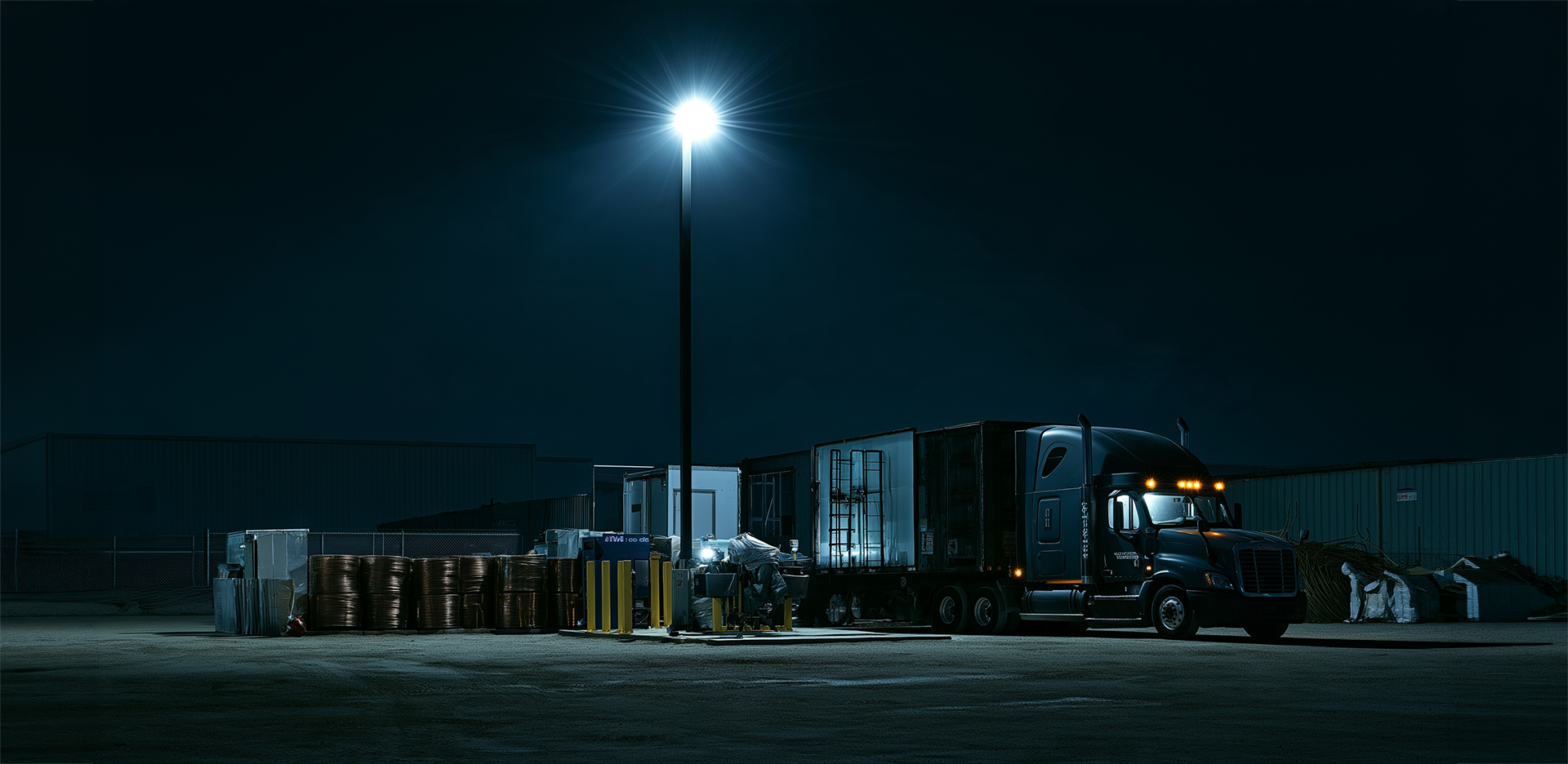
The freight most exposed to organized theft on the I-94 corridor isn't consumer electronics headed for store shelves. It's copper and data center hardware moving as ordinary dry freight. Measured against freight volume rather than raw incident counts, Illinois ranks at or near the top of both of the trucking industry's cargo theft indexes.
Two trailers in Elk Grove
On June 18, Cook County Sheriff's investigators got information about a trailer sitting at a truck yard on East Higgins Road in unincorporated Elk Grove Township. Inside was roughly $300,000 in copper wire, reported stolen out of Pine Hill, Alabama.
The yard's owner mentioned something else: the same person had dropped off another trailer a week earlier. That one had been reported stolen from Jacksonville, Florida, and held about $1 million in data center infrastructure equipment. Investigators found stolen plates on one of them. No arrests have been announced.
Read that sequence again. Two trailers, taken in two states roughly 500 miles apart, delivered a week apart to the same suburban Chicago yard by the same driver. That is not opportunism. That is a route, a staging point, and someone who knew where to put the freight until it could be moved.
The ranking nobody cites
California dominates the cargo theft headlines, and by raw incident count it should: it accounted for 36% of U.S. incidents in the first quarter of 2026, with Texas second at 17%. But raw counts mostly measure how much freight a state moves.
The American Transportation Research Institute took a different approach in its October 2025 study, The Fight Against Cargo Theft. ATRI indexed theft severity against each state's total freight activity, measured by annual vehicle miles traveled by tractor-trailers, and built two indexes: one from motor carrier losses, one from logistics service provider losses.
Illinois is the only state near the top of both.
| Rank | Motor Carrier | Logistics provider index |
|---|---|---|
| 1 | New Jersey (1.00) | Illinois (1.00) |
| 2 | Illinois (0.97) | California (0.98) |
| 3 | Pennsylvania (o.84) | Georgia (0.92) |
| 4 | Florida (0.70) | Nebraska (0.61) |
| 5 | Georgia (0.60) | Nevada (0.60) |
ATRI's own read: the higher motor carrier numbers for New Jersey and Pennsylvania point to pilferage and theft at carrier terminals, while the logistics provider figures for California and Georgia point to strategic theft at customer locations. Illinois is prominent on both lists, which means both problems are live here at once.
That corridor runs north out of Cook County straight up I-94 into Kenosha and Racine.
What's actually being taken
Illinois went from 6% of national cargo theft incidents in the first quarter of 2025 to 13% in the first quarter of 2026, according to supply chain risk firm Overhaul. Electronics made up 45% of the thefts recorded in the state.
"Electronics" is where the picture most people carry around stops being accurate. It no longer means pallets of flat screens. The Elk Grove recovery was copper wire and data center infrastructure hardware, the materials feeding a construction boom that has pushed copper into one of the fastest-growing property crime categories in the country. Server and networking equipment carries extraordinary value per pound, resells through channels that don't ask many questions, and travels in the same dry vans as everything else.
Two implications for anyone holding freight overnight. First, a trailer gives no outward sign of whether it's worth $8,000 or $1 million. Second, the people who target this freight know which is which before it reaches your gate, which means the exposure isn't random.
The corridor's profile holds up past Q1. Illinois' share of national incidents settled at 8% in the second quarter of 2026, still double the 4% recorded a year earlier, and Overhaul found rail theft most frequent in Illinois that quarter, ahead of California, Arizona, and Tennessee. Chicago's rail interchange is the reason, and it feeds everything moving north.
The corridor's profile holds up past Q1. Illinois' share of national incidents settled at 8% in the second quarter of 2026, still double the 4% recorded a year earlier, and Overhaul found rail theft most frequent in Illinois that quarter, ahead of California, Arizona, and Tennessee. Chicago's rail interchange is the reason, and it feeds everything moving north.
How they're taking it
The method has changed faster than most security budgets have. Using CargoNet data, ATRI tracked strategic theft (fraudulent pickups, carrier impersonation, double-brokering) from 2.2% of incidents in 2018 to 25% in 2023. Overhaul recorded deceptive pickup schemes rising another 31% year over year in Q1 2026.
That shift matters because it changes who the thief looks like at your gate. He arrives during business hours, in a clean truck, with paperwork. One Overhaul executive put it bluntly: when criminals are forging identities and impersonating carriers, a padlock on a trailer isn't going to stop them.
The locations are not what most people guess either. ATRI's survey of 95 motor carriers found the single most common place for a carrier to lose freight was its own terminal, at 24.3% of incidents, followed by overnight parking at 19.4% and truck stops or rest areas at 16.9%. For logistics providers, 50.5% of thefts happened at customer pickup locations.
Recovery is the part that should set the budget. Among motor carriers reporting to ATRI, 73.5% of stolen cargo was never recovered at all, and only 2% of incidents ended in a full recovery. Insurance doesn't close that gap: the most common loss fell in the $10,000 to $50,000 range, which for many carriers sits at or below the deductible.
Four questions worth asking about your own yard
1. Who was in the yard last night, and how would you know this morning?
A carrier's own terminal is the most common theft location in ATRI's data. Cameras that nobody watches in real time produce evidence after the fact, which is useful to an insurer and nearly useless for recovery. The question isn't whether you have footage. It's whether anyone saw the gate open while it was open.
2. Can your gate tell a legitimate driver from a convincing one?
This is where fraud-based theft wins. One large shipper interviewed by ATRI responded by refusing to release a load from high-risk sites without verifying the driver's license, the tractor and trailer numbers, the USDOT number, and the carrier's contact details. Theft incidents went from more than 13 in the prior year to four. The control that worked was a check at the gate, not a stronger lock.
3. What happens in the first hour after a trailer goes missing?
With roughly three out of four stolen loads never recovered, almost everything that determines the outcome happens before anyone files a report. Who notices, who they call, what they can tell responding officers about direction of travel: that should be a written procedure your night staff has practiced, not something improvised at 3 a.m.
4. Has your freight become more interesting than your security assumes?
If you're staging copper, electrical components, network hardware, or anything bound for a data center build, your risk profile changed when that market did. Security specified for general freight three years ago was specified for a different threat.
If the honest answer to any of these is "I'd have to check," that's worth a conversation before it's worth a claim.
Sources
- The Fight Against Cargo Theft: Insights from the Trucking Industry. American Transportation Research Institute, October 2025. State indexes, theft locations, recovery rates, and the strategic theft trend. Survey of 95 motor carriers and 28 logistics service providers reporting 2023 losses.
- U.S. Q1 2026 Cargo Theft Report. Overhaul. State shares, electronics figures, deceptive pickup schemes.
- $1.3M in stolen copper wire and data center equipment recovered near Chicago. FreightWaves, June 2026.
- Cook County crime: $1.3M in stolen cargo recovered. FOX 32 Chicago, June 2026.
- Fewer US cargo thefts offer little reprieve: Overhaul. Truck News, Q2 2026 data.